
Potter County Arrest Records and Charges
Potter County arrest records relate to the law-enforcement and custody side of a criminal event. They may involve an arresting agency, booking status, custody confirmation, bail, or jail information, although no official online Potter County jail roster or mugshot database was located. The official Sheriff and Jail pages are the local custody channels, and VINE or PADOC may help only in the specific custody contexts they cover.
Court charges after arrest are different. Once police file a complaint and the prosecutor decides which counts to pursue, the charges become part of the court record. Early entries may appear in a Magisterial District Court docket. If charges are held for court, the case moves to the Potter County Court of Common Pleas, where the Clerk of Courts side maintains the criminal file. The complete case outcome belongs with Potter County criminal court records, while the arrest-to-charge path is narrower.
| Point | Arrest Record | Court Charge Record |
|---|---|---|
| Primary source | Law enforcement, sheriff, jail, or custody systems. | Magisterial District Court, Common Pleas, Clerk of Courts, and UJS dockets. |
| Main purpose | Shows arrest, custody, booking, bail, or release context when public. | Shows filed charges, statute citations, grading, status, and disposition. |
| Online access | No official Potter County jail roster was located. | UJS Case Search is the main public docket source. |
| Limit | Custody information can change quickly and may be restricted. | A charge is an accusation unless it ends in conviction. |
Find Potter County Arrest Records
Potter County does not publish a public online arrest, mugshot, or live jail roster search in the county sources reviewed. For custody or booking confirmation, use the official Potter County Jail page, the Sheriff's Office, Pennsylvania VINE where the facility participates, and the court docket for charge and bail entries. For formal court charges, use Pennsylvania UJS Case Search.
- Start with UJS Case Search if the goal is to see filed charges, docket number, court dates, bail entries, or disposition.
- Search Magisterial District Courts for preliminary arraignment, preliminary hearing, traffic, summary, and first-stage criminal records.
- Search Common Pleas for CP-53 criminal dockets after charges are held for court or an information is filed.
- Call the Potter County Jail or Sheriff's Office for custody questions that are not answered by an online docket.
- Use PAePay only for eligible fines, costs, restitution, or payment balances, not as a complete arrest record source.
The Potter County Sheriff's Office is the county-level law enforcement office tied to civil process, courthouse security, transport, and warrant-related functions. County sources identify Kevin Siska as sheriff, and the employee directory gives the Sheriff's Office phone as 814-274-9350. The jail page is the custody source, but current custody should be confirmed directly because no official roster was found.
Charges After Arrest Documents
The charge record begins with a filed accusation and can change as the case moves. In Pennsylvania practice, a criminal complaint may start the court case at the MDJ level. After preliminary proceedings, the District Attorney may file a criminal information in Common Pleas. Indictments are included as a general charging-document concept, but Potter County's local path is mainly the complaint-to-information route through MDJ and Common Pleas processing.
| Document | Who Files It | Where It Appears | What It Means |
|---|---|---|---|
| Complaint | Police or prosecutor path at the start of the case. | Often first seen in Magisterial District Court records. | Starts the criminal accusation and identifies initial offenses. |
| Information | District Attorney after charges are held for court. | Potter County Court of Common Pleas criminal docket. | Formal charging document for the Common Pleas case. |
| Indictment | Grand jury in cases where that process is used. | Criminal court record when applicable. | Formal accusation from a grand-jury process, less central to Potter County's usual local pathway. |
Potter County Charge Status Table
Charge status should be read count by count. One arrest can produce several charges, and the court may resolve each in a different way. A charge may be pending while hearings are scheduled, amended when the prosecutor changes the allegation, reduced during plea talks, dismissed by the court, withdrawn, or marked nolle prosequi when the prosecution drops it. The final status, not the first charge list, is what tells the outcome.
| Status | What It Means | Record Reading Tip |
|---|---|---|
| Pending | The charge has not reached final disposition. | Check upcoming hearings, bail, motions, and continuances. |
| Held for court | The MDJ found enough basis for the charge to move to Common Pleas. | Look for a later CP-53 docket and information filed by the DA. |
| Amended | The charge was changed from its original form. | Compare original and current statute, grading, and description. |
| Reduced | The offense level or count was lowered. | Often appears near plea or negotiated disposition entries. |
| Dismissed | The court removed the charge or it did not proceed. | Do not treat a dismissed charge as a conviction. |
| Nolle prosequi | The prosecution dropped the charge. | Check whether other counts in the same case remain. |
| Guilty / convicted | The charge ended in a finding or plea of guilt. | Review sentence, probation, restitution, costs, and appeal status. |
Charge vs Conviction Records
Potter County charge records can include accusations that never become convictions. This is a critical distinction for employment, licensing, housing, and personal record review. A public docket may list the original charge because the case had to track it, but the outcome line may later show dismissal, withdrawal, acquittal, amendment, nolle prosequi, or conviction on a different count.
| Point | Charge | Conviction |
|---|---|---|
| Legal meaning | An allegation filed in court. | A final finding or accepted plea of guilt. |
| Proof level | May arise from complaint, probable cause, or prosecution filing. | Requires proof beyond a reasonable doubt or a valid guilty plea. |
| Docket location | Appears in early charge and event sections. | Appears in disposition, verdict, plea, and sentence sections. |
| Practical risk | Can be misread if the final status is ignored. | Can carry sentence, probation, costs, and collateral consequences. |
Potter County Charge Codes
Charge lines commonly include the offense description, statute citation, grading, OTN, filing police department, and status. Grading identifies how serious the charge is under Pennsylvania law, such as felony, misdemeanor, or summary offense. A single arrest can produce several charges with different grading levels, and each charge can follow its own path. The docket reader should not assume that all counts share one final outcome.
Magisterial District Courts are important for early charge coding because they handle preliminary arraignments, preliminary hearings, summary criminal matters, and traffic cases. Serious misdemeanor and felony charges can move to Common Pleas after preliminary proceedings. Once that happens, the Common Pleas docket usually becomes the main record for plea, trial, sentence, costs, and probation events.
Note: One Potter County arrest can create several charges, and each charge may have a different final status.
Bail and Warrant Entries
Arrest and charge records often intersect with bail and warrant entries. A docket may show preliminary arraignment, bail type, recognizance, surety, bail modification, bench warrant, failure to appear, bail revocation, or warrant recall. Those entries are court events, not a complete active warrant database. No official Potter County public active-warrant search page was located, so a docket clue should be followed by contact with the issuing court or counsel.
PAePay can help with eligible fines, costs, restitution, and traffic or criminal balances, but payment alone should not be assumed to clear a warrant or bail problem. The safer reading is to check the docket, identify the issuing MDJ or Common Pleas office, and obtain court confirmation. For current custody, use the jail, VINE where available, or official court orders rather than a charge list alone.
State Charge Record Limits
Pennsylvania criminal history and charge access is shaped by state law. 18 Pa.C.S. 9121 addresses dissemination and access limits for criminal history record information. 18 Pa.C.S. 9122 governs expungement of eligible criminal history records. The Pennsylvania Case Records Public Access Policy controls many court-record public access and redaction rules.
The statewide laws do not make every charge record public forever. Juvenile cases, sealed records, expunged records, mental health information, protected personal identifiers, and certain active investigative details can be withheld. Limited access can restrict public visibility without erasing every government record. Expungement requires eligibility and a court order. A Potter County defendant normally files in the court that handled the case and identifies the docket, charges, disposition, arresting agency, and relief requested.
Pennsylvania's limited-access statute is one of the state sources that affects public charge-record visibility.
Source: Pennsylvania limited access statute
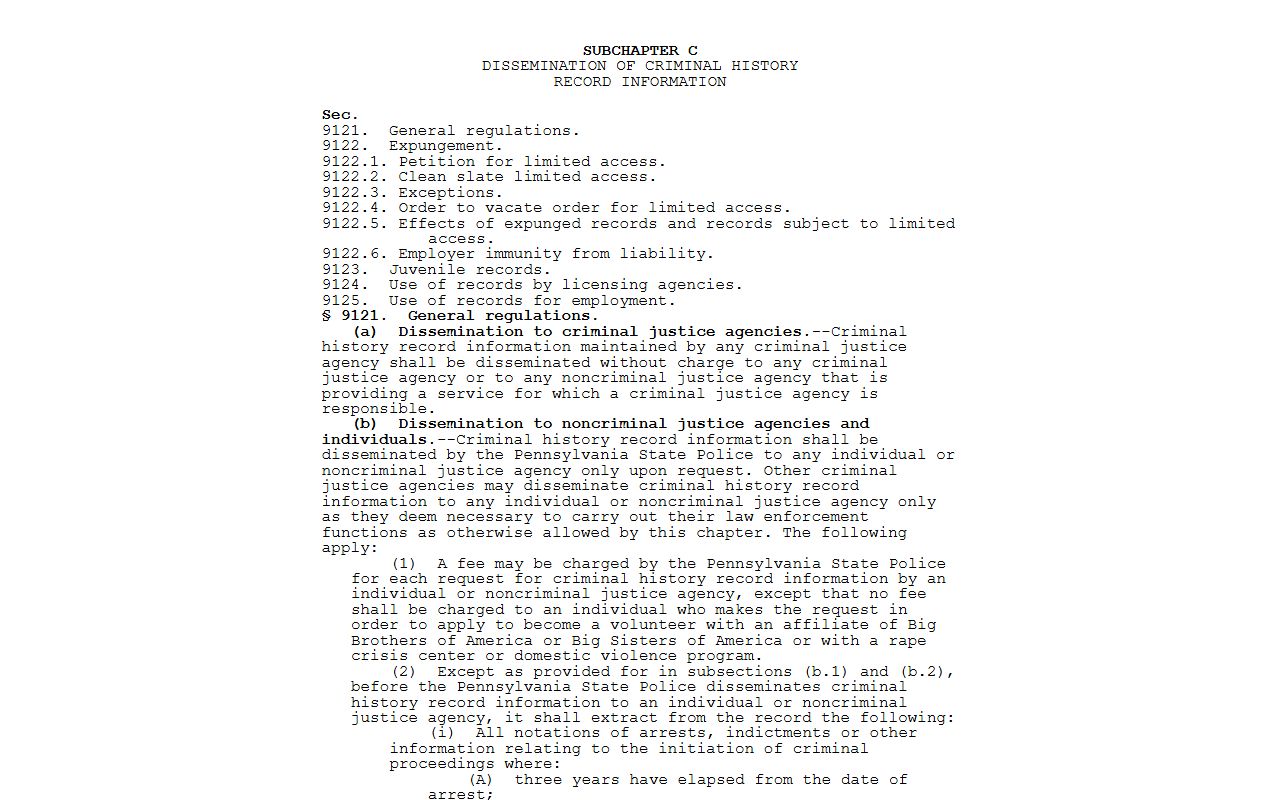
Limited access explains why a charge may be part of government history while ordinary public search visibility is restricted.
Sealed vs Expunged Charges
Sealing, limited access, and expungement should not be used as interchangeable terms. A sealed record is hidden from public inspection by law or court order. Limited access restricts dissemination of certain criminal history information. Expungement is a stronger remedy that removes or destroys eligible records as the court order directs. Eligibility depends on the outcome, offense, waiting period, and Pennsylvania law.
| Point | Sealed or Limited Access | Expunged |
|---|---|---|
| Public search effect | Record is hidden or restricted from ordinary public access. | Eligible record is removed or destroyed as ordered. |
| Common basis | Court order, public access policy, or 18 Pa.C.S. 9121 limits. | 18 Pa.C.S. 9122 and related criminal-record process. |
| Charge outcomes | Some records stay limited even if not destroyed. | Some acquittals, withdrawn or dismissed charges, and older eligible matters may qualify. |
| Potter County step | Ask the clerk what is public and what requires party status or order. | File the petition in the court that handled the case. |
The expungement statute is the statewide source for removing eligible criminal history records.
Source: Pennsylvania criminal history expungement statute
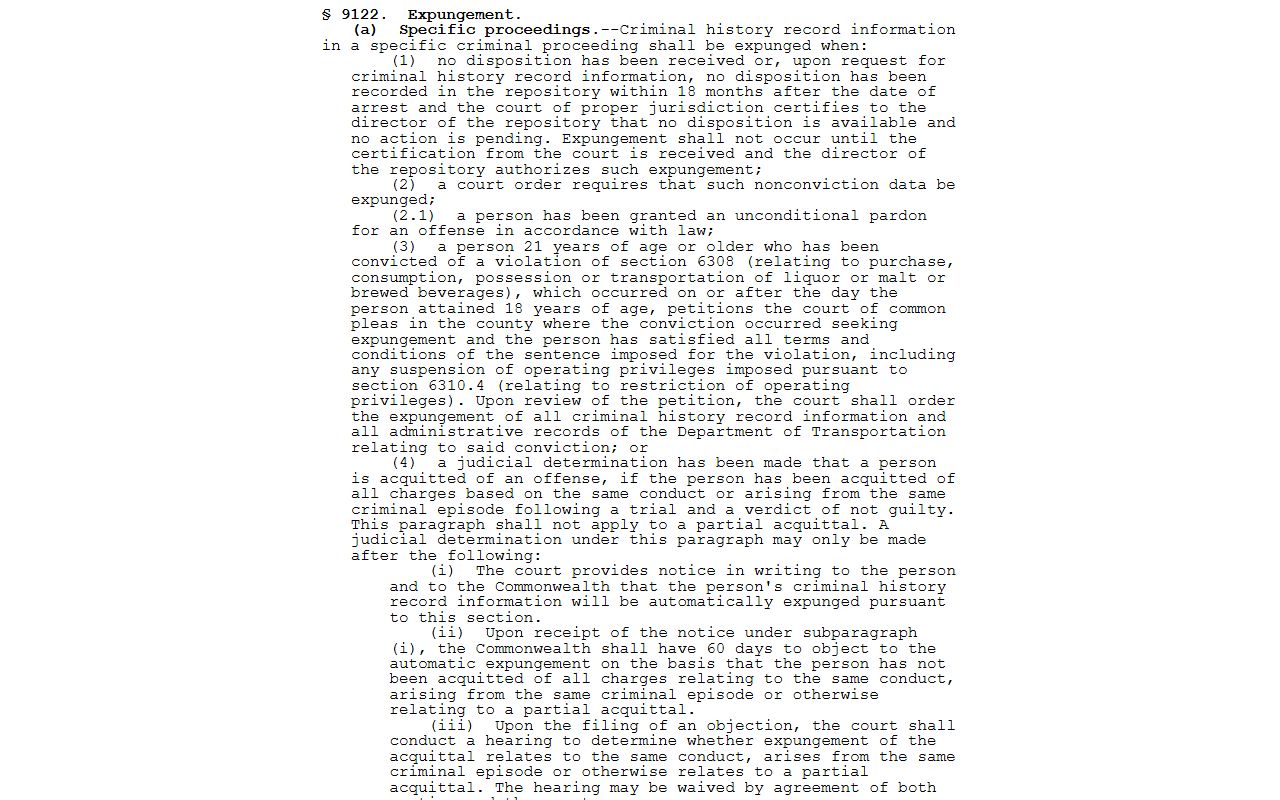
The statute supports cautious wording: a Potter County charge is not cleared automatically just because it is old or did not end in conviction.
Registry Records Are Separate
The Pennsylvania Megan's Law registry is a separate public system for reportable sex offender information. It is not a general Potter County arrest records search and it is not a complete criminal court file. Registry information may include offender profile fields, but it should not be used to infer all arrests, all charges, or all criminal history for a person.
For a specific Potter County criminal case, use UJS and the Clerk of Courts path. For custody status, use the jail, VINE, or PADOC depending on whether the person is local, state, or notification-system listed. For reportable sex offender information, use the official state registry rather than a local charge docket.
The Megan's Law registry is an official Pennsylvania public registry, but it serves a narrower purpose than arrest or charge lookup.
Source: Pennsylvania Megan's Law registry
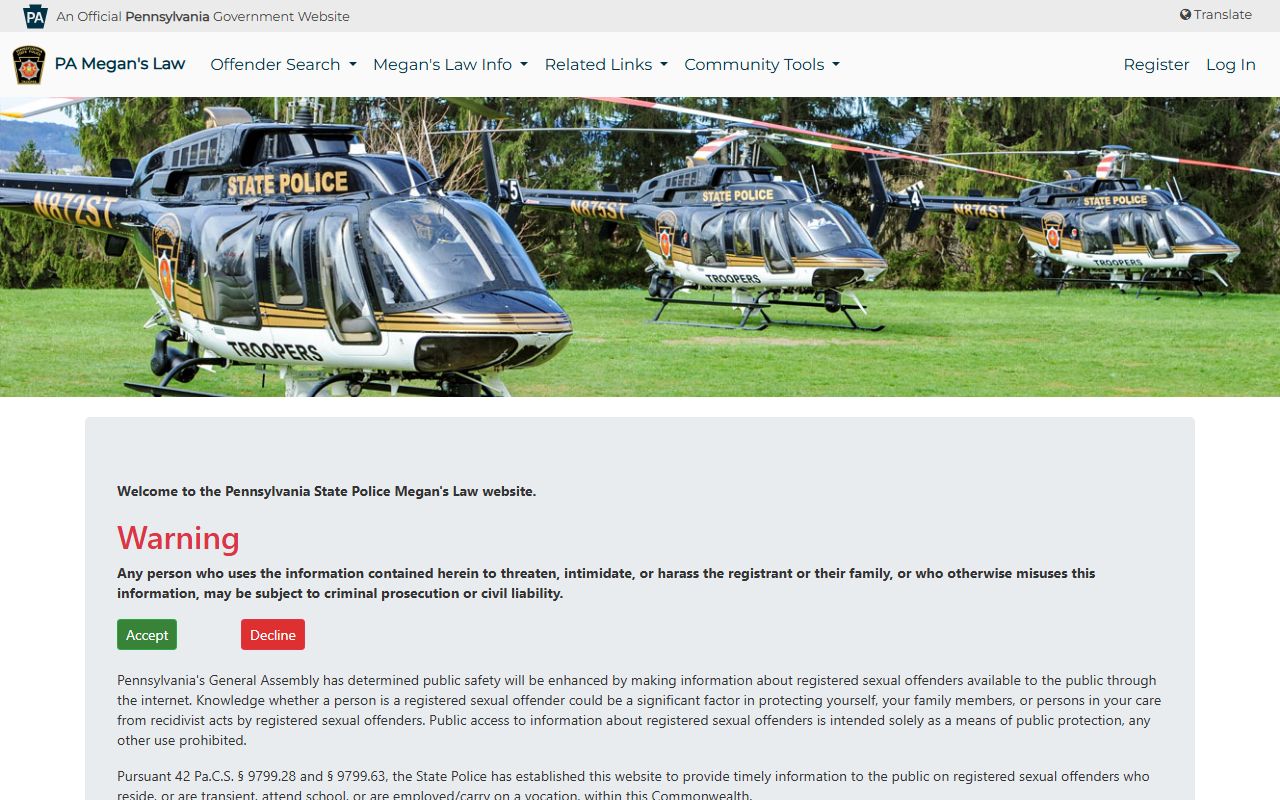
Keeping registry records separate from charge records reduces the risk of treating one public system as a full criminal history search.
Restricted Potter County Charge Records
Restricted charge records include juvenile matters, sealed cases, expunged records, confidential mental health content, protected identifiers, and records withheld under court policy or criminal history law. Dismissed or withdrawn charges may remain visible until a court grants expungement or limited access relief. A person who needs a record corrected, sealed, or expunged should work from the docket number and disposition rather than relying on a name search alone.
For formal copies, contact the Clerk of Courts side of the Prothonotary and Clerk of Courts / Clerk of Orphans' Court. For lower-court files, contact the issuing Magisterial District Court. For arrest or custody records that are not court files, use the Sheriff's Office, Jail, or county open-records route when appropriate. The public docket is the best starting point, but it is not the only source.